The Anthropic API Expert Workshop - RAG Pipelines, MCP Servers, AI Testing, and Responsible Production AI
About the Course:
Streaming a chat response is table stakes. This expert workshop is about what comes next: the architectural patterns that make AI features sustainable, maintainable, and safe in a production .NET environment.
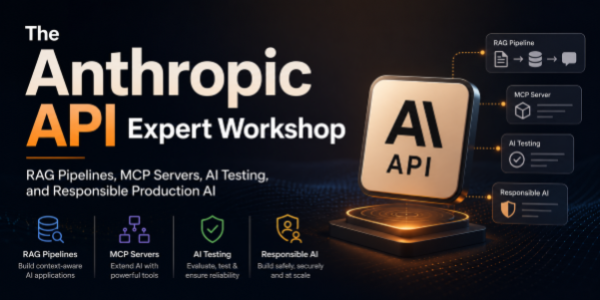
The workshop opens with Retrieval-Augmented Generation (RAG) pipelines built entirely in .NET, document chunking strategies, embedding generation, vector store integration, hybrid search, and the retrieval patterns that separate useful RAG from hallucination-amplifying RAG. You will build a working pipeline against a real document corpus and learn to benchmark retrieval quality.
The second session covers the Model Context Protocol (MCP): how to author a custom MCP server in C# that exposes your company's existing databases, APIs, and internal services as AI-accessible tools. This is the capability that transforms Claude from a general assistant into a specialist who knows your system.
The final session addresses the concerns that separate prototypes from production: AI-powered test generation, embedding Claude into GitHub Actions for automated review, prompt injection defense in ASP.NET Core endpoints, token budget governance, and hallucination mitigation patterns specific to .NET code generation. You will leave with working code and a responsible AI checklist you can apply immediately.
Course Objectives:
Upon completing this workshop, participants will be able to:
- Design and implement a RAG pipeline in .NET with document chunking, embedding, vector storage, and hybrid retrieval
- Evaluate and benchmark RAG retrieval quality and diagnose common failure patterns
- Implement the extended thinking pattern in C# for complex multi-step reasoning tasks
- Design and build a custom MCP server in C# that exposes internal databases and APIs as Claude-accessible tools
- Register and test a custom MCP server end-to-end against a live Claude session
- Integrate AI-powered test generation into an existing .NET test suite
- Embed Claude API calls into a GitHub Actions workflow for automated code review and release notes
- Implement prompt injection defense patterns in ASP.NET Core endpoints that accept user-supplied content
- Apply token budget governance to keep AI feature costs economically viable at scale
- Identify and mitigate hallucination patterns specific to .NET and C# code generation tasks
Who is the Target Audience?
- Developers who have completed the Anthropic API Beginners Workshop or have equivalent C# SDK experience
- Senior .NET engineers architecting AI-native features for production applications
- Software architects evaluating RAG and MCP patterns for enterprise .NET deployments
- DevOps and platform engineers are integrating AI capabilities into CI/CD pipelines and developer toolchains
- Principal and staff engineers responsible for AI safety, governance, and cost management on .NET teams
- CTOs and engineering leaders are evaluating the Anthropic platform for team-wide production deployment
- AI application engineers building enterprise-grade generative AI systems on .NET
- Machine learning engineers transitioning into production LLM application architecture using C# and ASP.NET Core
- Platform engineering teams building reusable AI infrastructure and internal AI service layers
- Backend API engineers implementing retrieval systems, tool calling, and AI orchestration workflows
- Enterprise integration engineers connecting internal systems, databases, and APIs to AI platforms through MCP servers
- Cloud solution architects designing scalable and cost-governed AI application architectures
- AI engineering leads responsible for operationalizing LLM-powered features across multiple products
- Data platform engineers supporting vector databases, embeddings pipelines, and semantic search infrastructure
- Search and information retrieval engineers exploring hybrid search and RAG optimization techniques
- Engineering teams building internal knowledge assistants, support copilots, or enterprise search platforms
- SaaS engineering teams embedding AI capabilities into commercial .NET applications
- Technical founders and startup CTOs building AI-native SaaS products with .NET technologies
- AI security engineers focused on prompt injection defense, model misuse prevention, and secure AI application design
- Application security teams evaluating risks in AI-enabled ASP.NET Core endpoints and APIs
- Governance and compliance teams defining responsible AI deployment standards for enterprise software
- Engineering productivity teams implementing AI-assisted code review, test generation, and automated documentation workflows
- Quality engineering and QA automation teams integrating AI-generated testing into CI/CD pipelines
- Release engineering teams exploring AI-powered release notes, deployment validation, and workflow automation
- Infrastructure architects evaluating production deployment patterns for retrieval systems and AI services
- Teams building internal developer assistants using MCP servers and proprietary enterprise knowledge sources
- Developers creating domain-specific AI assistants backed by organizational APIs and structured data
- Organizations building AI-powered customer support, document intelligence, or internal knowledge systems
- Technical consultants implementing enterprise RAG architectures and AI governance practices for clients
- FinOps and engineering operations teams are responsible for AI token usage governance and cost optimization
- Teams evaluating long-context workflows and retrieval optimization for large enterprise document collections
- Data engineers supporting ingestion pipelines for embeddings, chunking, indexing, and semantic retrieval systems
- AI operations (AIOps) teams interested in monitoring, benchmarking, and evaluating LLM application quality
- Engineering organizations building AI readiness frameworks and internal AI enablement programs
- Technical innovation groups researching production-safe AI implementation patterns for enterprise software
- Teams migrating from prototype AI demos to maintainable, scalable production AI architectures
- Software reliability engineers evaluating hallucination mitigation and validation strategies for AI-generated outputs
- Architects designing multi-system AI orchestration using MCP protocols and external enterprise services
- Organizations developing regulated-industry AI solutions that require strong governance and validation controls
- Teams implementing retrieval-enhanced coding assistants or AI-powered developer support tooling
- AI-focused developer advocates and technical educators teaching production AI engineering practices in .NET ecosystems
- Engineering managers are planning the organization-wide adoption of AI-enhanced testing and deployment workflows
- Technical teams evaluating vector database strategies and retrieval benchmarking methodologies
- Developers building AI-enhanced enterprise portals, chat systems, and intelligent workflow automation tools
- Companies are establishing internal standards for secure, auditable, and economically sustainable AI development
- Advanced .NET developers preparing to specialize in AI platform engineering or applied LLM systems development
Basic Knowledge:
A half-day virtual workshop for .NET developers who already know the Anthropic SDK basics. Build production-grade RAG pipelines, author custom MCP servers in C#, integrate AI into your test suite and CI/CD pipeline, and apply responsible AI practices that keep features economically viable and secure.
- Completion of the Anthropic API Beginners Workshop or equivalent
- Solid ASP.NET Core, C# 10+, and Entity Framework Core knowledge
- Basic familiarity with vectors and embeddings is helpful but not required
Required Accounts:
- Anthropic Console account with API access via paid plan or Claude Pro/Max subscription. Estimated workshop spend: $5–10.
- GitHub account with permission to create repositories and Actions workflows.
- Azure free-tier account recommended for the vector store and deployment lab (azure.microsoft.com/free).
System Requirements:
- Visual Studio 2022 (latest stable), VS Code (latest), or JetBrains Rider. The Claude Code VS Code extension will be installed during the workshop.
- Windows 10/11 (64-bit), macOS 12 Monterey or later, or Ubuntu 20.04+ / Debian 10+. Windows users should install WSL2 before the workshop.
- RAM: 16 GB minimum; 32 GB recommended if running Docker Desktop alongside your IDE.
- Disk Space: 20 GB free minimum for SDK, tooling, Docker images, and the workshop repository.
- Local administrator rights required to install Claude Code and other tooling.
- A stable broadband internet connection is required throughout. All API calls and lab exercises require internet access.
Instructor Note:
- Participants should have the Anthropic C# SDK installed and a vector database accessible (instructions in the pre-workshop guide). The GitHub Actions lab requires a GitHub account with Actions enabled. A pre-workshop environment guide will be distributed one week in advance.